
KSK70 Diaries - 5*

*This is a series of articles consisting of assessments by Gülfer Kırbaş, who attended the 70th meeting of the Commission on the Status of Women (CSW) on behalf of ÇemberDE.
I attended 16 events at CSW last week. That's a bit much, and it's just my greed. What can I do, I love it :)
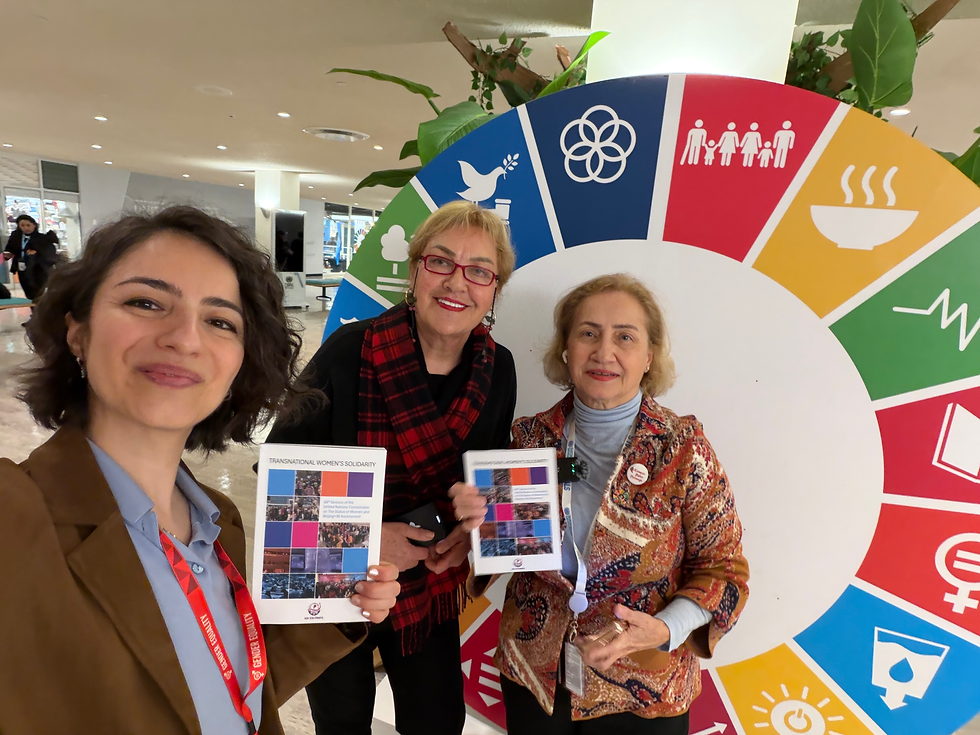
I finished the day with 5 more events. They were on different topics: artificial intelligence, environmental work, women's political representation, local economy… But we kept coming back to the same question: who controls the power, technology, and money?
One session discussed “green jobs” and the environmentally friendly economy. The example given from India was striking: a system was established to facilitate access to credit for street vendors (mostly women), increasing the income of hundreds of thousands of small business owners. Once this relationship of trust was established, circular economy practices began: reducing product loss, reusing waste, and small-scale production.
Well;
We cannot plan for tomorrow without solving poverty. First, we must feed ourselves today so that we have the strength to think about tomorrow together.
A parliamentarian from Uganda explained why women are central to environmental policies: in the country, women do most of the farming, but they own only a very small portion of the land. There are policy documents, but often nobody at the local level is aware of them. Therefore, the question of how environmental policies, development, and international frameworks like CEDAW will be implemented locally has repeatedly come up. Without localization, these policies lose their meaning.
Companies run by women have been able to reduce carbon emissions much more than others. Green initiatives increase when women have more say in the household. If we took the helm a little more, we would steer the course in the right direction, but they won't let us. Not only do they not let us, but they also channel funding to anti-equality movements and AI to prevent us from getting close to the helm.
In another session, technology was discussed. In a debate on AI, media, and misogyny, one speaker recalled an example from this week: the CEO of a technology company had openly stated that artificial intelligence could be used to weaken the political power of female voters in America, who tend to vote more for Democrats.
Then someone in the audience pointed out an ironic detail: such an approach actually underestimates the importance of the humanities and critical thinking. Yet many believe the opposite: in the age of technology, discussions on social sciences, ethics, and politics will be perhaps more important than ever.
Another discussion was about money.
In rights struggles, tracking the flow of money is one of the quickest ways to understand the direction of politics. Today, billions of dollars are flowing into artificial intelligence technologies. At the same time, the limited resources available to women's organizations have been highlighted once again.
This inevitably leads to the following question:
Are investments in technology, environmental policies, and debates about democracy truly separate issues?
Perhaps this is precisely where the issue converges.
Who is investing in artificial intelligence, and for what purpose?
Whose lives are truly being changed by the eco-friendly economy?
For whom do international conventions and rights mechanisms work at the local level?
Equality is not just a goal, but also a matter of power and resources.


Comments