
What does CSW69 tell us?*

When discussing gender equality, we often explain that those in power are unwilling to relinquish it and will try every means to do so. That power exists both at home and at the head of the state. However, the current state of women's rights worldwide and the attitudes of governments paint a picture of significant regression.
*This article was originally published on the Koç University Gender and Women's Studies Research and Application Center (KOÇ-KAM) website blog. https://kockam.ku.edu.tr/csw69-bize-neler-soyluyor/

Governments are discussing women's rights in many ways, making joint decisions, declaring intentions, and establishing principles for gender equality worldwide. Try to imagine this; it might seem like a utopian scene given your current situation...
For example, if you are a woman in Adıyaman affected by the earthquake and struggling to survive with her three children in a 21 m² space for two years; if you are in Trabzon , fearing your husband will kill you because your protection order is insufficient, and have resorted to making a video and posting it on social media; if you are a Yazidi or Alawite girl threatened by military groups in Syria ; if you are a woman trying to escape to South Korea, leaving her children behind in North Korea; or if you are an immigrant woman in the US forced to work without health insurance due to a chronic illness… It is not easy to imagine states coming together to discuss your needs. In such situations, we often feel invisible. But I must say, these meetings are actually taking place, and I have witnessed them firsthand.
What is the state? Is it the arms of Leviathan (1), or is it made up of people like you and me? I think we have long forgotten “who” the state is. The state has become an inaccessible and unaffected structure. Yet history shows us that people can transform states (Moghadam, 2005). The women's movement is one of the strongest examples of this. Women all over the world have learned from each other, been encouraged by seeing each other, and brought about great transformations. Many of the rights we have today are the product of the organized struggle of ordinary women.
One of the key turning points in this struggle was the establishment of the United Nations in 1945, which brought the international status of women to the forefront (Fraser, 2013). Where were women when the United Nations was founded after overcoming numerous obstacles and achieving what we now consider inaccessible unity among states? No one suddenly started discussing women's needs or opening doors for women to be included in these mechanisms. Women were pursuing their rights and worked hard to bring this to the attention of states. As a result of these efforts, the 'status of women' began to be specifically addressed, and policies were developed in this area.
A significant example occurred in Beijing in 1995. While governments were meeting to discuss the status of women, organized activist women, who had already been instrumental in making this process work, gathered in Huairou, near Beijing (UN Women, 2020). It sounds easy when you say it like that, but try to imagine the tens of thousands of women, tens of thousands of women without state support, who went to China at that time. They traveled for days, stayed in tents, and worked. They went to Beijing to explain their real agenda and shaped the situation there. Even writing this fills me with enthusiasm. At that time, the most comprehensive and visionary women's rights document to date was written in Beijing and adopted by all countries. So what can Serap, who cannot protect herself from male violence through legal means and seeks help on social media, learn from this story? What can Ayşe, who walks home at night fearing for her safety, learn? What can we learn?
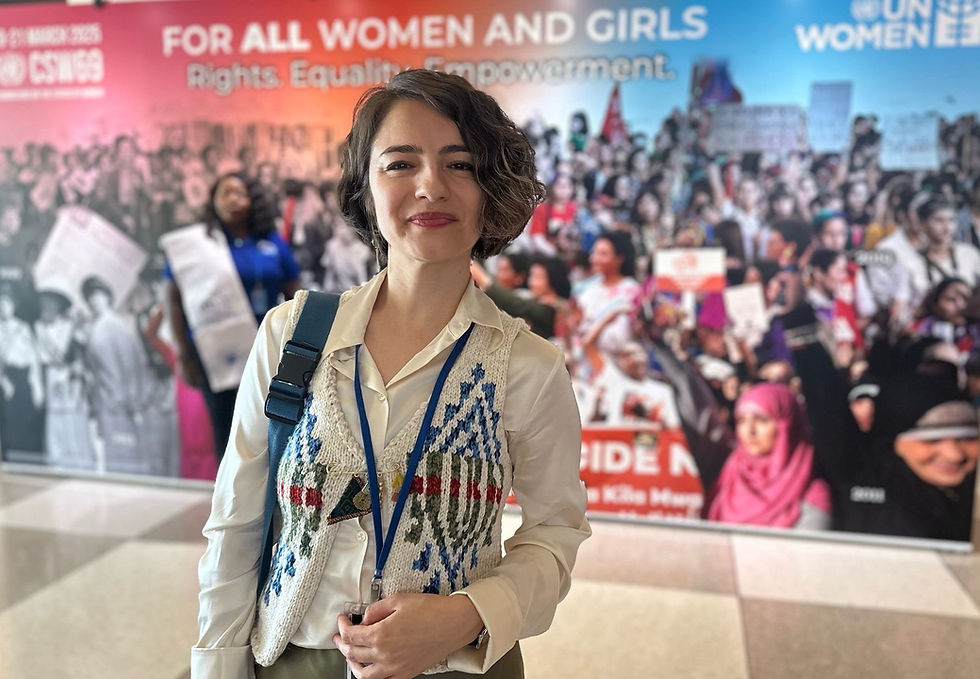
This year I went to New York, specifically to witness the scene described in the first sentence. I had the chance to attend the 69th Session of the UN Commission on the Status of Women (CSW69) . This year's sessions were held with an agenda specifically addressing the current situation, marking the 30th anniversary of the Beijing Declaration of 1995. Who am I, attending this meeting? I am a woman who grew up in a suburban neighborhood of Eskişehir, somehow managed to get an education, and, seeing the suffering of women, starting with my own, has tried to change and transform this situation, creating safe spaces in various parts of Anatolia during various crises. Even for me, as someone who has worked in this field for a long time, imagining the scene I mentioned above, being a part of it, wasn't easy. This year in New York, I witnessed it.
It's true. We women made this scene a reality.
What we've accomplished is truly exciting. Of course, I take ownership of the success; I think we should take even more ownership. What are we doing, how is all this happening? Women who are knowledgeable about the state of women's rights in their countries, essentially civil society, are able to work together with government delegations, directly conveying their views and creating the declarations and resolutions that are now so impressive to read. Meanwhile, there are difficult negotiations, and governments are persuaded of these ideas. Countries then make their internal arrangements in accordance with the decisions made here (Htun & Weldon, 2018). Then, women, even those who don't attend these meetings, and most importantly, us, can follow the implementations of their own countries by referencing these decisions, and we feel stronger. But do we feel sufficiently influential in these decisions today?
When discussing gender equality, we often explain that those in power are unwilling to relinquish it and will try every means to do so. That power exists both at home and at the head of the state. However, the current state of women's rights worldwide and the attitudes of governments paint a picture of significant regression.
While reports highlight progress within the legal framework, indicators on the ground are worrying. Women's poverty is increasing structurally, the care labor crisis is deepening, and anti-gender discourse is becoming institutionalized internationally (True, 2012). Some states object to the concept of gender, blocking its inclusion in texts. The scope for civil society participation is being narrowed. The discrepancy between state reports and the reality on the ground is further exacerbated by the lack of independent data and monitoring mechanisms . Accountability regarding conventions such as CEDAW has weakened.
In short, the struggle against power-hungry structures that reject equality and peace continues. But we women have once again loudly declared that we are not afraid of Leviathan: We will not back down.
Even today, as women, we can still influence states and international decision-making processes, however challenging and sometimes exhausting it may be. These decisions are not just texts; they are the tangible results of solidarity, courage, and organized labor. Serap, Ayşe, and all women who are trapped and threatened must know that our struggle is powerful and effective.
I saw this in New York: behind the sentences spoken in those grand halls and on those podiums lies the years-long struggle of us women. And perhaps most importantly, the state is not as distant and inaccessible as we think. We are the ones who transform the state, who influence its decisions; it is our voice, our presence.
Let's take a closer look at that utopian scene today. We now know that it's not just a dream; it's real. But for it to be real, someone needs to be there, to tell the story, to negotiate. Our next question should be: How can we expand our presence on that scene and become more effective?
Speaking for myself, I now know that no matter how difficult it is, we women can always have a voice at those tables. All we need is belief, organization, and to amplify each other's voices.
Because we are not invisible. We are certainly not ineffective.
[1] Leviathan: A metaphor used by the English philosopher Thomas Hobbes in his 1651 work, Leviathan. Hobbes defines the state as a central authority that emerges from a social contract and protects the rights of individuals but possesses absolute power. Source: Hobbes, T. (1651). Leviathan. London: Andrew Crooke.
Source
Fraser, N. (2013). Fortunes of feminism: From state-managed capitalism to neoliberal crisis. Verso Books.
Hobbes, T. (1651). leviathan London: Andrew Crooke.
Htun, M., & Weldon, S. L. (2018). The logic of gender justice. Cambridge University Press.
Moghadam, V. M. (2005). Globalizing women: Transnational feminist networks. Johns Hopkins University Press.
True, J. (2012). The political economy of violence against women. Oxford University Press.
UNWomen. (2020). Beijing Declaration and Platform for Action .


Comments